UPSC CSE 2031 · Offline Classroom · English Medium
UPSC GS Full Syllabus Course 2031 – Offline Classroom
Build your UPSC CSE 2031 preparation through English-medium classroom learning at ClearIAS Academy, Kowdiar, Thiruvananthapuram. The Topmost Plan provides a physical academic anchor for early starters who need direct teaching, peer accountability and mentor access, while recorded support, study materials, current affairs, tests and examination-skill guidance help connect the long foundation period with the eventual Prelims, Mains and Interview cycle.
- English-medium classroom classes at ClearIAS Academy, Trivandrum
- A phased classroom pathway aligned with the UPSC CSE 2031 target year
- General Studies preparation connected across Prelims, Mains and Interview
- Recorded support for revision and continuity after unavoidable absence
- Current affairs, CSAT, Essay, tests and guidance within the learning system
- Campus routine, peer learning and direct support to prevent long-horizon drift
Confirm the current batch start, complete timetable, campus arrangements, seat availability, faculty sequence, instalment options, validity and purchase-page terms before payment or relocation. Digital access and classroom onboarding may follow separate activation steps.
A long-range classroom preparation system
Choose the 2031 Topmost Plan When a Campus Routine Will Strengthen Your Long-Term Preparation
A distant target year creates both an advantage and a danger. You gain time to learn without panic, but you can also mistake attendance for progress. The 2031 classroom route is most valuable when the campus timetable becomes the backbone of a phased plan: foundation first, application next, repeated revision after that, and examination simulation only when the attempt year approaches. It suits students who can attend in Thiruvananthapuram consistently and still reserve substantial time for independent output.
This long-horizon classroom plan is particularly useful when you need:
- A stable weekly anchor while balancing graduation, work or other responsibilities
- Direct explanation and correction before misconceptions become permanent
- Periodic academic accountability across a preparation horizon of several years
- A serious peer environment that supports effort without encouraging comparison anxiety
- Recorded continuity for revision while classroom participation remains the primary route
UPSC CSE 2031
Offline Classroom Topmost Plan · English Medium
A premium classroom pathway for early starters who want direct instruction, a disciplined campus environment, recorded continuity and staged General Studies preparation through the 2031 attempt cycle.
₹1,29,999
Limited Period Offer
Campus: ClearIAS Academy, Kowdiar, Thiruvananthapuram
Course validity: Until 31 October 2031
Validity may be extended further on payment of the applicable extension fee, subject to the policy available at that time.
Access: Available digital resources may be activated after successful payment; classroom participation follows the current batch schedule and onboarding instructions.
Pay the complete course fee in a single payment to receive an additional ₹2,000 discount. Use code SAVE2000 at checkout. This offer is applicable only for one-time payment of full fees and does not apply to instalment payments.
How to get the Instalment Option: Scroll to the bottom of the payment page and select the instalment plan. Students may pay the course fee in three instalments, with a gap of 30 days between each payment.
A five-year runway needs changing levels of intensity
Prepare in Phases: Foundation Now, Examination Intensity Later
A 2031 target may suit undergraduates, early-career professionals and beginners whose eligibility or life plan makes an earlier serious attempt unrealistic. Such aspirants should not study at maximum intensity for several years. The better approach is to build durable knowledge first, introduce application steadily, preserve academic or professional continuity, and increase test-oriented work as the attempt approaches.
Foundation Without Hurry
Develop conceptual command in major GS areas without the shallow reading and source-hopping that often accompany a compressed preparation cycle.
Skills Before the Final Year
Introduce MCQ reasoning, short answers, Essay frameworks and CSAT checkpoints early enough for repeated correction rather than last-minute repair.
Protect Graduation and Career Progress
Use a sustainable plan that allows you to complete college, build employability or continue work while steadily accumulating UPSC competence.
Revisit, Update and Prune
Return to core subjects through spaced revision, update changing areas and remove obsolete current-affairs details so the knowledge base remains usable.
Face-to-face learning in Thiruvananthapuram
Use the Campus to Create a Feedback Loop Between Teaching, Practice and Correction
ClearIAS conducts offline classes at its Kowdiar campus in Thiruvananthapuram, Kerala. For a 2031 aspirant, the campus should provide more than a place to hear lectures. It should create a repeatable feedback loop: learn in class, reconstruct the idea independently, apply it to a question, identify the gap and return with a sharper doubt or correction request.
- Preview the topic: Read the syllabus phrase and scan one or two previous-year questions before class.
- Extract the framework: Listen for relationships, arguments, evidence and common traps rather than attempting a verbatim transcript.
- Rebuild from memory: After class, reproduce the structure without looking at the notes and identify what you cannot recall.
- Ask a better doubt: Use the classroom or mentor channel for the exact conceptual gap revealed by retrieval and practice.
- Close the cycle: Complete one relevant MCQ set, answer outline, map, diagram or oral explanation before treating the topic as finished.
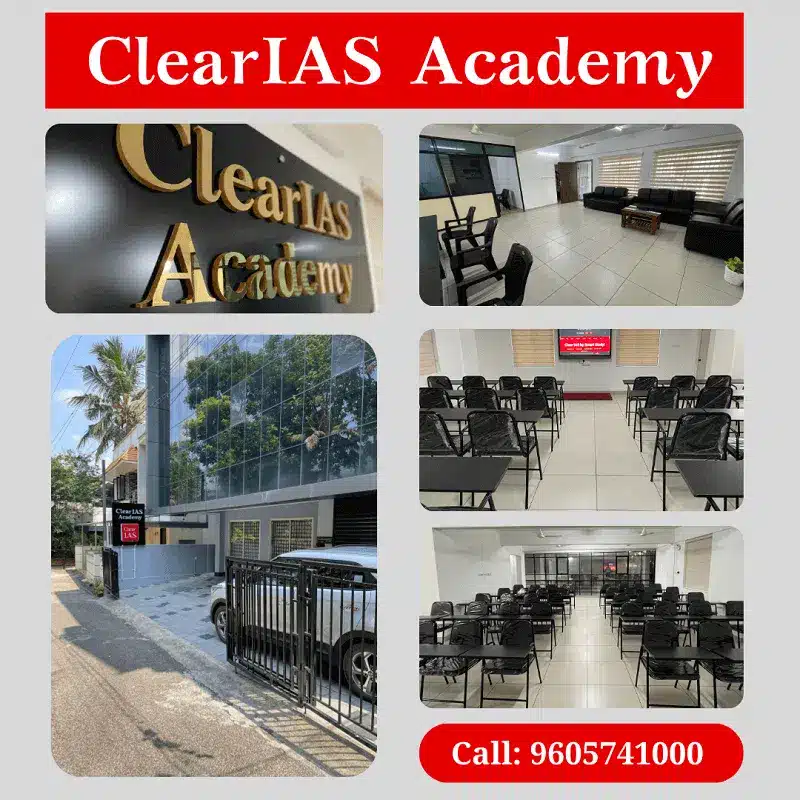
Build a weekly engine that can run for years
A Sustainable Class–Recall–Application Cycle for the 2031 Batch
Published course information describes weekday classes from 7 PM to 9 PM, a Saturday Weekly Current Affairs class and a Sunday online mock examination. Because 2031 is a long-horizon target, the weekly system must be repeatable rather than heroic: attend, retrieve, apply, review and clear pending work before it compounds.
Class-Day Anchor
Review the previous framework and identify one question you want the new class to help answer before entering the classroom.
Next-Day Retrieval
Reconstruct the lesson, compress it into a revision sheet and mark its syllabus and PYQ connections before the next subject block.
Weekly Issue Update
Use the current-affairs session to update a limited set of syllabus-linked issue notes rather than producing a permanent archive of daily news.
Sunday Error Review
Attempt the applicable test, separate knowledge gaps from judgement errors and carry only two or three priority corrections into the following week.
What the integrated course brings together
A Classroom Core Supported by Recordings, Resources, Tests and Mentorship
The current course information positions the Offline Topmost Plan as an integrated General Studies program rather than a stand-alone lecture series. Exact availability, schedules and formats may evolve across the batch, so the final enrolment page and onboarding communication should be treated as authoritative.
Interactive Classroom Classes
Attend English-medium General Studies classes at the ClearIAS Academy campus and use direct academic interaction for conceptual clarity.
Recorded Backup
Use available recordings for revision, difficult topics and genuine missed-class recovery under the applicable platform and access rules.
500+ Expert Video Classes
The existing course information describes an extensive recorded learning base supporting Prelims, Mains and Interview preparation.
1500+ Topic-wise PDFs
Use organised materials to supplement classroom teaching and create concise revision resources without multiplying unnecessary sources.
Current Affairs Support
Connect significant developments with static subjects, Prelims concepts, Mains issues and Interview-level understanding.
Tests and PYQ Practice
Develop accuracy, elimination, time management and error-analysis habits through the listed examination components.
CSAT, Essay and Skill Support
Address qualifying-paper preparedness, written expression and examination strategy alongside the General Studies syllabus.
Mentorship and Doubt Support
Use the available guidance channels to correct priorities, resolve preparation barriers and plan the next measurable stage.
One syllabus, three examination stages
Build a Reusable General Studies Knowledge System for 2031
A long-horizon student needs notes that can survive several revisions and updates. Organise every classroom topic under the official syllabus, attach relevant previous-year questions, separate stable concepts from changing facts, and schedule the next retrieval date before adding another source.
Core General Studies Areas
- Indian Polity and Governance
- Indian Economy
- Ancient, Medieval and Modern History
- Art and Culture
- Indian and World Geography
- Environment and Ecology
- Science and Technology
- International Relations
- Internal Security
- Disaster Management
- Society and Social Issues
- Ethics, Integrity and Aptitude
Examination Skills to Build Alongside Content
- Prelims MCQ reasoning
- Intelligent elimination
- CSAT qualifying-paper readiness
- Mains answer structure
- Use of examples and evidence
- Maps, diagrams and flowcharts
- Essay planning and coherence
- Previous-year-question analysis
- Test-time decision-making
- Error classification
- Current-affairs integration
- Interview-oriented articulation
Classroom plus organised digital access
Use the Dashboard as a Continuity Tool Between Campus Sessions
The course information states that available contents can be accessed through a mobile device or laptop. The representative ClearIAS dashboard includes areas such as Content, Live Classes, Attendance and Announcements, while subject folders and sequential lesson lists help students locate resources without relying on scattered links.
- Use Content for organised study: Enter subject folders and proceed through the relevant lesson sequence.
- Use recordings selectively: Revisit difficult explanations or recover unavoidable missed sessions without replacing regular attendance.
- Track official communication: Check the applicable announcements and batch channels for schedule or access updates.
- Separate access from completion: Mark a lesson complete only after notes, recall and practice have been finished.
- Keep a local progress sheet: Record subject completion, revision dates, test errors and pending doubts outside the dashboard as well.

Six horizons from early foundation to the 2031 attempt
Change the Nature of Preparation as the Examination Moves Closer
The same study intensity and material mix should not continue for five years. Use the following horizons to decide what the classroom course should produce at each stage, while adjusting the calendar to your actual enrolment date and eligibility.
1. Orientation Horizon
Confirm eligibility, graduation timing, examination stages, syllabus boundaries, Optional requirement and a sustainable weekly commitment.
2. Concept Horizon
Complete foundation readings and explain the central ideas of major GS subjects in your own words without depending on a notebook.
3. Coverage Horizon
Finish the first coherent GS cycle with concise notes, PYQ mapping and a planned revision date for every completed subject.
4. Application Horizon
Increase topic-wise MCQs, answer outlines, short responses, maps and diagrams while maintaining a recurring-error register.
5. Integration Horizon
Substantially complete the Optional, connect current affairs with static GS and begin mixed-subject revision and testing.
6. Examination Horizon
Move toward full-length simulation, rapid revision, CSAT security, answer-writing speed and decisions under timed conditions.
Annual Pruning Review
Remove outdated fact sheets, merge duplicate notes and retain only the current-affairs material that still explains a live syllabus issue.
Quarterly Output Audit
Review completed subjects, revisions, tests, writing samples and pending classes every twelve weeks; reset the plan before backlog becomes identity.
A repeatable conversion method for every classroom topic
Learn, Retrieve, Apply and Review Before Calling a Topic Complete
Learn
Extract the main framework, important distinctions, evidence, diagrams and faculty corrections instead of reproducing the lecture word for word.
Retrieve
Close the material and reconstruct the concept, sequence or argument from memory; uncertainty here reveals the real learning gap.
Apply
Use the topic in an MCQ set, answer framework, short explanation, map or diagram so that knowledge becomes usable under examination conditions.
Review
Schedule the next retrieval, record the mistake and update the note only when new information materially improves the framework.
Decide whether the campus should be a long-term base or a phased commitment
Evaluate the Total Academic, Financial and Lifestyle Cost of Offline Preparation
A student targeting 2031 may not need to relocate at maximum intensity for every year of the runway. Before paying or moving, evaluate whether you will use the campus continuously, commute locally, or combine an initial classroom phase with later independent preparation. Accommodation, travel, health, food, study space and career continuity must remain sustainable.
Academic Feasibility
- Class timings and attendance consistency
- Daily self-study hours after commute
- College or office schedule compatibility
- Optional-subject preparation plan
- Access to a quiet revision space
- CSAT and answer-writing practice time
- Test participation and analysis time
- Long-term health and sleep routine
Financial and Logistical Feasibility
- Accommodation and deposit
- Food and daily living costs
- Local travel or commute
- Device and internet expenses
- Books and Optional-course costs
- Visits home and emergency travel
- Medical and contingency buffer
- Duration of the relocation commitment
Check fit before enrolment
Is the 2031 Offline Classroom Plan the Right Long-Term Format for You?
This course can be a strong fit when you:
- Can attend the Kowdiar campus consistently for the current batch schedule
- Need physical structure and direct interaction to maintain momentum
- Want an early but serious start for a realistic 2031 attempt
- Can protect daily self-study time in addition to classroom hours
- Will use recordings as backup rather than as permission to skip classes
- Are prepared to track outputs, revision and test errors independently
Compare another mode first when you:
- Have unpredictable work, college or family commitments
- Cannot reliably reach the campus during the published class window
- Prefer complete control over pace and study timing
- Would lose excessive time or money through daily travel or relocation
- Already have strong self-discipline and need only flexible resources
- Are eligible for an earlier serious attempt and should not defer unnecessarily
Choose the learning mode—not merely the highest plan
Recorded Online vs Live Online vs Offline Classroom for UPSC 2031
All three 2031 plans follow the integrated Prelims, Mains and Interview approach. The main difference is the level of scheduling, interaction, physical attendance and flexibility.
Unbeatable Plan
Ultimate Plan Most Recommended
Topmost Plan
Reduce the expectation gap before joining
Evaluate Teaching Online, Then Verify the Real Campus Experience Before Committing
Public demo classes help you evaluate clarity, pace, conceptual depth, Prelims–Mains linkage and question-solving orientation. Interface previews show how digital resources are organised. They cannot confirm the present classroom batch, seat status, faculty timetable, facilities or day-to-day campus process.
What the Demo Page Helps You Evaluate
- Teaching clarity and language
- Conceptual depth
- Examination relevance
- Prelims–Mains integration
- PYQ and elimination orientation
- Mobile and laptop interface
- Subject-folder organisation
- Compatibility with your learning style
What You Should Confirm with Admissions
- Current batch commencement
- Full weekly timetable
- Faculty and subject sequence
- Seat availability
- Campus-visit arrangements
- Recording and digital-access rules
- Tests, evaluation and mentorship format
- Final fee, instalments and validity
Frequently asked questions
FAQs About the ClearIAS UPSC 2031 Offline Classroom Course
What is the current fee for the UPSC 2031 Offline Classroom Course?
The current ClearIAS GS Full Syllabus catalogue lists a regular fee of ₹2,25,000 and a current fee of ₹1,29,999. The final payable amount, taxes, offer status and payment options shown on the ClearIAS Academy purchase page at enrolment will apply.
Why does an older course page show a different fee?
The older individual page may still display ₹2,35,000 reduced to ₹1,39,999. This landing page follows the more recent central course catalogue. Always verify the final payable amount on the purchase page before payment.
Where are the classroom classes conducted?
Offline classes are conducted at ClearIAS Academy in Kowdiar, Thiruvananthapuram, Kerala. Confirm the current venue and campus-visit process with the admissions team.
What is the published weekly schedule?
The existing course information describes Monday-to-Friday classes from 7 PM to 9 PM, a Saturday Weekly Current Affairs class and a Sunday online mock examination. Timings can change, so verify the latest batch schedule before admission.
How long is the UPSC 2031 course valid?
The published course validity is until 31 October 2031. Further extension may be available on payment of the applicable extension fee, subject to the policy in force at that time.
Do offline students receive recorded classes?
The program is described as live classroom learning plus recorded classes. Recordings may support revision and continuity, but exact availability, upload timing and access rules should be confirmed for the current batch.
Can I access the digital course on a mobile phone or laptop?
The current course information states that available contents can be accessed through a mobile device or laptop. The approved app, browser, login, device and viewing rules communicated during onboarding will prevail.
Is this course suitable for a complete beginner?
It can suit beginners who want a guided foundation, direct explanation and a physical routine. Beginners must still develop independent reading, revision, question practice and test-analysis habits.
Is the 2031 batch suitable for undergraduate students?
It can be suitable when 2031 aligns with graduation and UPSC eligibility, and when college attendance, examinations and commute leave adequate time for classroom participation and self-study.
Can working professionals join the offline course?
Yes, when office hours, commute and personal responsibilities permit reliable attendance plus additional study. Professionals with unpredictable schedules should compare the Live Online and Recorded Online plans.
Does the full-syllabus GS fee include an Optional subject?
No. This is a General Studies full-syllabus course. Optional-subject courses are listed separately because aspirants choose different Optional subjects.
Are current affairs, CSAT, Essay and tests included?
Published program information lists current-affairs classes, CSAT, Essay, Prelims tests, previous-year-question retake exams and related support. Confirm the exact format, frequency and availability for the current batch.
How should a 2031 aspirant manage current affairs over several years?
Focus on recurring issues and their links with static syllabus areas. Maintain concise issue-based notes, update them periodically and remove outdated event-level details rather than storing every daily news item.
When should I begin answer writing?
Begin gradually after gaining basic topic knowledge. Start with frameworks and short answers, then improve depth, evidence, speed and full-test performance over successive preparation stages.
Should I visit the campus before paying or relocating?
A visit is advisable when practical, especially for students relocating or making a major long-term financial commitment. Contact admissions first to confirm the visit process and current batch details.
Are instalment or EMI options available?
The legacy detail page states that instalment or EMI options may be available. The actual options, charges, eligibility and payment schedule shown on the current checkout page will apply.
Does admission guarantee selection in UPSC CSE?
No course can guarantee selection, rank or marks. Results depend on eligibility, sustained effort, revision, practice, judgement and performance in the examination.
Ready to build a disciplined 2031 pathway?
Join Only When 2031 Is the Correct Attempt and the Campus Model Is Sustainable
Choose this course when 2031 is your earliest realistic serious attempt and when face-to-face instruction, campus accountability and direct academic support justify the time and cost of regular attendance in Kowdiar. Begin with a phased plan for foundation, GS coverage, Optional, revision, writing, CSAT and tests rather than a vague intention to remain enrolled for several years.
ClearIAS UPSC 2031 Offline CoursePrelims · Mains · Interview
English-medium classroom General Studies preparation in Thiruvananthapuram with recorded support and an integrated long-term learning system.
₹1,29,999
Campus: ClearIAS Academy, Kowdiar
Validity: Until 31 October 2031
Admission: Digital activation follows successful payment; classroom onboarding follows the current batch instructions
Need help with admission or a campus visit?
Talk to a ClearIAS Course Mentor
Ask about the current 2031 classroom batch, timetable, seat availability, campus visit, fee, instalments, validity, digital access, inclusions or whether an online plan would suit you better.
Campus: A Street, Kanaka Nagar, Opposite Raj Bhavan, Kowdiar P.O., Thiruvananthapuram, Kerala – 695003
ClearIAS does not guarantee selection, rank or marks. Course content, faculty, batch status, schedules, support formats, tests, fees, offers, taxes, validity, extension rules, campus arrangements and platform features may change. Verify the final information on the relevant enrolment page and with the admissions team before purchase or relocation.