
Hoysala Temples (11th-13th Century) are the Jewel of Medieval Deccan Architecture. They got UNESCO World Heritage site recognition in 2023. Read here to know more about the splendour of the Hoysalas.
Several lesser-known Hoysala temples across Karnataka are drawing renewed attention for their extraordinary soapstone carvings and distinctive star-shaped architecture.

Built between 1050 and 1300 CE, these monuments represent one of the most refined phases of Indian temple architecture.
The Hoysalas ruled large parts of present-day Karnataka and Tamil Nadu, with key centres at Belur and Halebidu (ancient Dwarasamudra).
Hoysala Dynasty
The Hoysala dynasty began as feudatories of the Western Chalukyas before asserting independence.
Capitals:
- Initially: Belur
- Later: Dwarasamudra (modern Halebidu)
Notable Rulers:
- Vishnuvardhana
- Veera Ballala II
- Veera Ballala III
Vishnuvardhana (formerly Bittideva) expanded the kingdom and initiated large-scale temple construction. He converted from Jainism to Vaishnavism under the influence of the saint Ramanuja, reflecting the era’s religious dynamism.
Architectural Identity: The Vesara Synthesis
Hoysala architecture is often termed the Vesara style, blending:
- Northern Nagara features
- Southern Dravida elements
However, over time, it evolved into a uniquely Hoysala idiom, distinguished by sculptural density and geometric experimentation.
Hoysala Temples: Core Architectural Features
Material: Soapstone (Chloritic Schist)
Hoysala architects used chloritic schist, commonly called soapstone.
Advantages:
- Soft when quarried- allowed microscopic detailing
- Hardens on exposure- long-lasting durability
The result:
- Intricate jewellery
- Fingernails and hair curls
- Textured drapery and ornaments carved with near-miniature precision
Ground Plan Innovations:
Hoysala temples display remarkable experimentation in shrine arrangements:
- Ekakuta- single sanctum
- Dvikuta- two shrines
- Trikuta- three shrines
- Chatushkuta- four shrines
- Panchakuta- five shrines
These were typically built on a raised platform called jagati, often in a stellate (star-shaped) plan.
Distinctive Stellate Plan:
Unlike the cruciform Panchayatana layout seen elsewhere, Hoysala temples:
- Have multiple projecting angles
- Create rhythmic recesses
- Maximize sculptural surface area
This geometric complexity is a hallmark of the style.
Sculptural Narratives:
The outer walls function like visual scriptures.
Common motifs include:
- Friezes of elephants (symbol of strength)
- Horses (speed and royalty)
- Foliage patterns
- Scenes from Ramayana and Mahabharata
- Celestial dancers (madanikas)
- Dynamic mythological battles
The sculptural bands are arranged horizontally in systematic layers.
Shikhara (Superstructure):
- Towers are tiered and compact.
- Horizontal mouldings divide them into rhythmic sections.
- Unlike towering Dravida vimanas, Hoysala shikharas appear proportionate and ornamented.
Ornamental Density:
Decoration covers:
- Interior walls
- Exterior walls
- Pillars
- Ceilings
- Doorframes
Even deities’ jewellery is intricately carved.
The lathe-turned pillars inside mandapas reflect remarkable engineering skill.
Prominent Hoysala Temples
Hoysaleswara Temple
- A grand Shiva temple.
- Built in the 12th century.
- Walls resemble sculpted epics.
- Dense friezes and dynamic reliefs.
It represents the height of Hoysala sculptural ambition.
Chennakeshava Temple
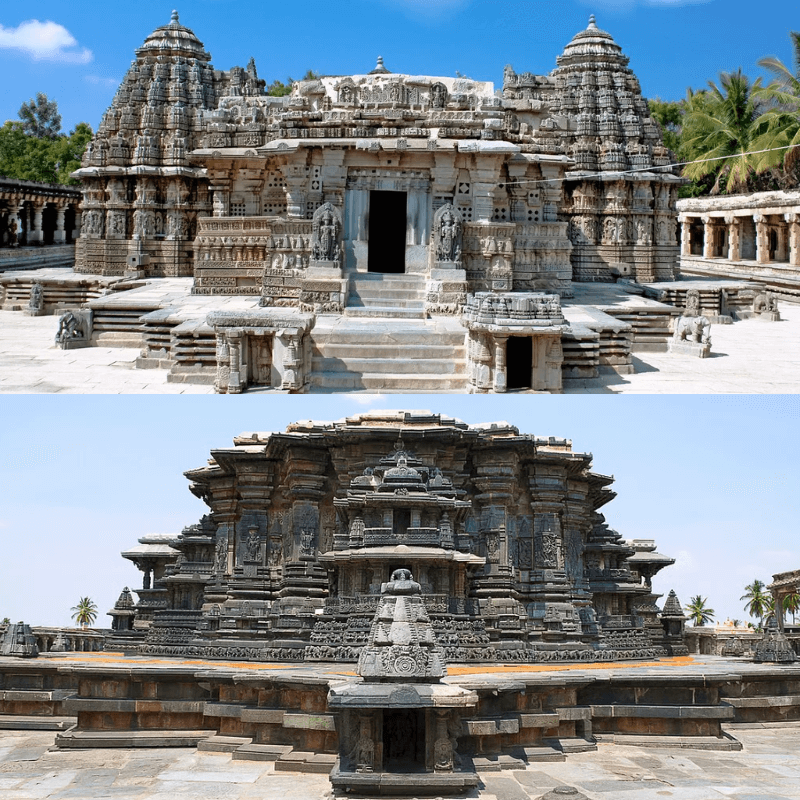
- Commissioned by King Vishnuvardhana.
- Dedicated to Vishnu.
- Built to commemorate victory over the Cholas.
- Known for exquisite madanika figures.
A “living temple” with continuous worship.
Keshava Temple
- 13th-century Trikuta Vaishnava temple.
- Built by Somanatha Dandanayaka under Narasimha III.
- Perfect example of mature Hoysala design.
Veera Narayana Temple

Built around 1200 CE by Veera Ballala II.
It is known for:
- Expansive ranga-mandapa
- Rows of sculpted elephants
- Emphasis on interior grandeur over exterior ornamentation
Nageshwara & Govindeshwara Temples (Koravangala)
- Reflect early experimental phase.
- Show transition from Chalukyan influence to full Hoysala maturity.
Bucheshwara Temple (1173 CE)

- It marks the high point of sculptural density and star-shaped platform perfection.
Lakshminarasimha Temple (Javagal)
- Trikuta shrine.
- Elephant friezes.
- Built during Vira Someshwara’s reign.
- Reflects trade prosperity.
Lakshmidevi Temple (1114 CE)
- One of the earliest surviving monuments.
- Commissioned by merchant woman Sahaja Devi.
- Contains rare Mahakali shrine with tantric symbolism.
Panchalingeshwara Temple (Mandya)
- Rare Panchakuta layout.
- Five east-facing Shiva shrines.
Jain Basadis of Halebidu

Parshvanatha, Shantinatha, and Adinatha Basadis display:
- Minimal ornamentation
- Clean lines
- Meditative aesthetic
Reflect the religious pluralism of the Hoysala rule.
Hulikere Kalyani
- 12th-century stepped tank.
- Miniature shrines are symbolically linked to zodiac signs.
- Integrates cosmology and hydraulic engineering.
UNESCO Recognition
In 2023, three major temples were inscribed as a UNESCO World Heritage Site under the title: “Sacred Ensembles of the Hoysalas”
Included:
- Chennakeshava Temple
- Hoysaleswara Temple
- Keshava Temple
The inscription took place during the 45th World Heritage Committee session.
Distinguishing Features Compared to Other Styles
Feature |
Hoysala |
Chola |
Nagara |
Material |
Soapstone |
Granite |
Sandstone |
Plan |
Star-shaped |
Axial |
Curvilinear tower |
Ornamentation |
Extremely dense |
Moderate |
Vertical emphasis |
Platform |
Raised jagati |
Usually absent |
Varies |
Cultural Significance
- Demonstrates religious plurality (Shaiva, Vaishnava, Jain)
- Reflects royal patronage and mercantile prosperity
- Shows the peak of Deccan sculptural art
- Integrates cosmology, geometry, and devotion
Conclusion
Hoysala temples represent the culmination of Deccan temple architecture – a perfect synthesis of geometry, sculpture, and devotion.
Their star-shaped platforms and microscopic carvings stand as testimony to medieval India’s technical mastery and aesthetic sophistication.
In the narrative of Indian art history, the Hoysalas mark the moment when stone became poetry.

IAS/IPS/IFS Smart Preparation Strategy: FREE Mentorship – Register Now!
Aim IAS/IPS/IFS?





Leave a Reply