
Himalayan Pangolin has been revalidated as a Distinct Species, separating it from the Chinese pangolin. Read here to learn more about the species.
The recent revalidation of the Himalayan pangolin (Manis aurita) as a distinct living species marks a significant milestone in mammalogy, taxonomy, and wildlife conservation.

For decades, it was considered a subspecies or population of the Chinese pangolin (Manis pentadactyla), but comprehensive morphological, genetic, and biogeographical studies have now confirmed that it represents an evolutionarily distinct lineage.
The discovery has profound implications for biodiversity conservation in the Himalayas, particularly for India, Nepal, and Tibet, as the species faces severe threats from habitat degradation and illegal wildlife trade.
What is the Himalayan Pangolin?
The Himalayan pangolin (Manis aurita) is a nocturnal, solitary, insectivorous mammal belonging to the family Manidae, the only family of mammals covered with protective keratin scales.
Like all pangolins, it is highly specialised for feeding on ants and termites and plays an essential ecological role by naturally controlling insect populations, thereby maintaining forest ecosystem health.
Unlike the Chinese pangolin, the Himalayan pangolin has evolved under the unique environmental conditions of the Himalayan mountain ecosystem, making it genetically and morphologically distinct.
Taxonomic Classification
Taxonomic Rank |
Classification |
Kingdom |
Animalia |
Phylum |
Chordata |
Class |
Mammalia |
Order |
Pholidota |
Family |
Manidae |
Genus |
Manis |
Species |
Manis aurita |
Why Was It Revalidated?
For several decades, the Himalayan pangolin was grouped with the Chinese pangolin because of their superficial similarities.
Recent international research confirmed that the Himalayan populations have been genetically isolated for millions of years, justifying recognition as an independent species. The research involved:
- Whole genome sequencing
- Morphological analysis
- Cranial measurements
- Evolutionary history
- Biogeographical modelling
Habitat and Distribution
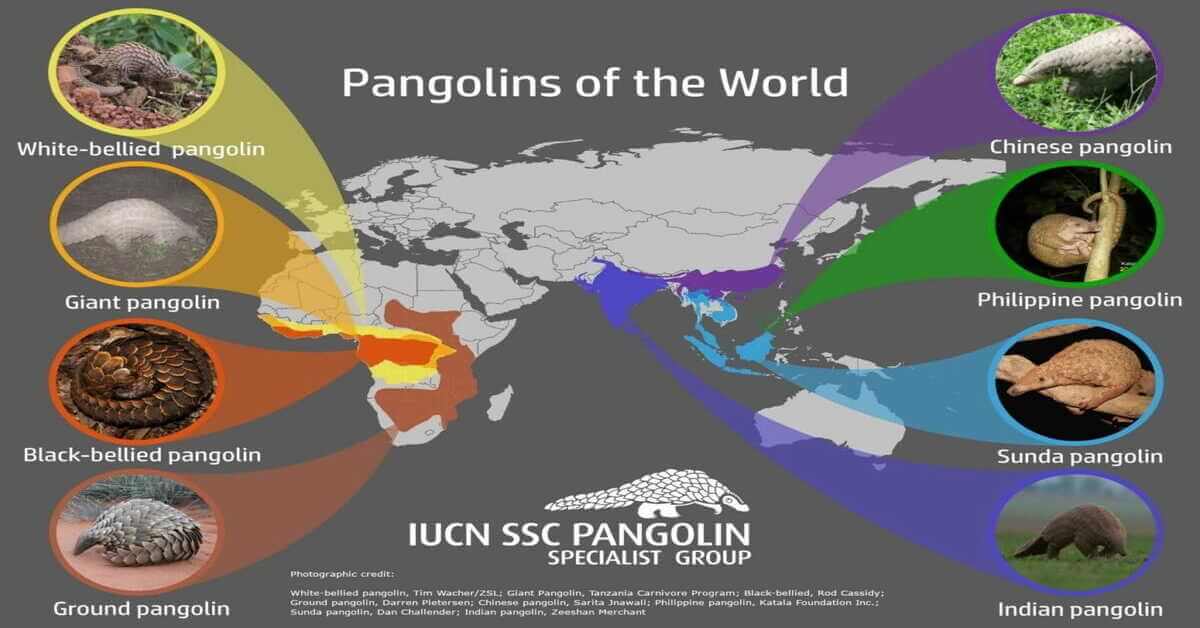
The Himalayan pangolin is endemic to the southern Himalayan region.
It is found in:
- Nepal
- South Tibet (China)
- Northeast India
- Assam
- Eastern Himalayan forests
The species prefers areas where ant and termite colonies are abundant, like-
- subtropical forests
- temperate forests
- mountain foothills
- forest edges
- shrublands
Evolutionary Isolation: Researchers found that the species became isolated due to major geographical barriers, such as:
- Brahmaputra River Basin
- Arakan Mountain Range
- Himalayan uplift
- deep river valleys
These natural barriers prevented gene flow with Chinese pangolin populations, allowing the Himalayan pangolin to evolve independently over millions of years.
Physical Characteristics
Scale Armour
- Like all pangolins, its body is covered with overlapping keratin scales, the same material found in human fingernails.
- When threatened, it curls into a tight ball, exposing only its hard scales.
Body Size
Compared with the Chinese pangolin,
- Larger body
- Larger skull
- Average body length is about 95 cm
Reduced External Ears
One of its distinguishing characteristics is the presence of
- very small
- highly reduced external ear pinnae.
Broad Nose
- It possesses shorter nasal bones and a broader snout, which improves olfactory efficiency.
Behaviour
Nocturnal and solitary
- The Himalayan pangolin remains inside underground burrows during daylight and becomes active only after sunset.
- Except during mating season or while raising offspring, individuals live alone.
Excellent Diggers
It possesses powerful forelimbs and extremely long, curved claws used for
- excavating burrows
- breaking termite mounds
- digging ant nests.
Exceptional Sense of Smell
Unlike most mammals,
- Vision is poor
- Hearing is limited
Instead, it depends almost entirely on smell.
Its enlarged olfactory bulb and complex nasal structures help detect insect colonies hidden beneath the soil.
Feeding Habit
The Himalayan pangolin feeds primarily on:
- ants
- termites
- insect larvae
Using its long, sticky tongue, which may exceed the length of its body cavity, it rapidly captures thousands of insects during feeding.
Since it lacks teeth, food is crushed inside the muscular stomach with the help of swallowed grit.
Reproduction
The species has one of the slowest reproductive rates among mammals.
- Usually one offspring
- Long gestation period
- Low reproductive success
Newborns possess soft scales that gradually harden.
The mother carries the young on her tail until it becomes independent.
The slow reproductive cycle severely limits the recovery of depleted populations.
Ecological Importance
The Himalayan pangolin is an important ecosystem engineer. It contributes to natural pest control as a single pangolin can consume millions of ants and termites annually.
Soil Aeration
Its burrowing activities
- loosen compact soil
- improve water infiltration
- enhance nutrient cycling.
Forest Health
- By regulating termite populations, pangolins reduce excessive wood degradation and help maintain ecological balance.
Threats
Illegal Wildlife Trade
- Pangolins are among the most trafficked mammals in the world.
- They are hunted for meat, traditional medicine, and scales, despite the scales having no scientifically proven medicinal value.
Habitat Loss
- Expansion of roads, settlements, agriculture, and logging reduces suitable habitat.
Low Reproductive Rate
- Slow breeding makes recovery extremely difficult after a population decline.
Climate Change
- Changing temperatures and altered insect distributions threaten food availability in mountain ecosystems.
Inbreeding
- Researchers observed severe localised inbreeding in Himalayan populations, especially around the Kathmandu Valley, increasing extinction risk.
Himalayan Pangolin vs Chinese Pangolin
Feature |
Himalayan Pangolin (Manis aurita) |
Chinese Pangolin (Manis pentadactyla) |
Taxonomic Status |
Distinct species |
Distinct species |
Ear Size |
Very small |
Larger |
Nasal Bones |
Broad and short |
Long and narrow |
Body Size |
Larger |
Smaller |
Habitat |
Himalayan forests |
Southern China and Southeast Asia |
Evolution |
Himalayan refuge |
Southern Chinese forests |
Inbreeding |
Severe localized spikes |
Widespread baseline inbreeding |
Conservation Status
Although recently recognised as a distinct species, the Himalayan pangolin is expected to require an independent conservation assessment.
Conservation measures include:
- habitat protection
- anti-poaching operations
- strengthening wildlife law enforcement
- transboundary cooperation among India, Nepal, Bhutan, and China
- community awareness programmes
- scientific monitoring using genetic tools
Significance for India
The discovery has several important implications:
- Recognises India’s Himalayan region as home to a unique endemic mammal.
- Requires species-specific conservation planning rather than treating it as part of the Chinese pangolin population.
- Strengthens biodiversity documentation in Northeast India.
- Enhances India’s role in global pangolin conservation.
- Supports ecosystem conservation in fragile Himalayan forests.
Way Forward
- Conduct nationwide population surveys using molecular techniques.
- Develop a dedicated conservation action plan for Manis aurita.
- Strengthen habitat connectivity across the Eastern Himalayas.
- Intensify anti-trafficking enforcement under the Wildlife (Protection) Act, 1972 and international agreements such as CITES.
- Promote community-based conservation and awareness in pangolin habitats.
- Encourage collaborative research among Himalayan countries for long-term monitoring and genetic conservation.
Conclusion
The recognition of the Himalayan pangolin (Manis aurita) as a distinct species represents a major advancement in evolutionary biology and wildlife conservation.
Beyond correcting its taxonomic identity, the discovery highlights the rich yet fragile biodiversity of the Himalayas and underscores the need for targeted conservation strategies.
Protecting this unique mammal from habitat loss and illegal trafficking will be crucial for preserving one of the world’s most specialised and ecologically important insectivores.

IAS/IPS/IFS Smart Preparation Strategy: FREE Mentorship – Register Now!
Aim IAS/IPS/IFS?






Leave a Reply